Feeds:
Posts
Comments

My analysis of latest events in light of the reaction of US neocons and political elite to the declining US Empire:

The USA is descending into a state of general lawlessness, at home and abroad. From using domestic special ops paramilitary units (ICE) to kidnap people off the streets of America and send them abroad, the US government is now deploying secret special ops military units (Delta Force) to snatch foreign heads of governments from their homes and sending them to jail in the US.

Political human trafficking has become the rule of law in America under the current Trump administration!

Before 2025, the two political parties engaged in a crescendo of lawfare actions against each other, employing the FBI, the courts and even the CIA behind the scene to destroy each other. Both parties engaged in abuse of the rule of law, pardoning family, rich friends, and business partners to protect themselves and their personal relations, rendering a travesty of the fiction that in America no one is above the law. Senior politicians of both enriched themselves, becoming multi-millionaires after leaving office after arranging special deals while in.

The recent US invasion of Venezuela a gross violation of international law. A hypocritical disrespect for sovereign boundaries that US neocon ideologues and their echo chamber captured US media have leveled at Russia in Ukraine the past four years.

Trump himself has publicly admitted the invasion of Venezuela was intended to secure US economic control of Venezuela’s natural resources, especially its oil reserves. In other words, good old fashion naked US imperialism, intended to grab another country’s natural resources.

The excuse was the nonsense charges of narco drug trafficking—i.e. the US neocons’ substitute excuse for WMD’s, weapons of mass destruction, used before in Iraq, Syria, Libya to justify US military intervention.

WMDs couldn’t be levied at Venezuela. Wouldn’t work. Nor would past excuses for US imperial intervention like ‘Remember the Maine’. ‘Tonkin Gulf’. Or ‘Killing Incubator Babies’. The neocons needed a new fake excuse for US imperial military intervention in Venezuela. So they looked into their magic bag of false flags, fake excuses, and CIA lies and pulled out  ‘Narco drug trafficking’. That works better for Latin America imperial interventions—as former president of Panama, Noriega, found out in 1989.   

Watch out Colombia president Gustavo Petro who defended Venezuela sovereignty and criticized Trump’s Venezuela action. And heed the warning Mexico president, Sheinbaum! You’re the next Trump targets. Ditto Cuba.

Does Greenland have a president Trump can threaten? Wonder what that excuse will be. Maybe the US must invade because ‘Chinese ships are melting the ice cap’.

And make no mistake. Trump’s not only engaged in naked military imperialism in Venezuela to enact regime change. His big mouth ‘spilled the beans’ that the US plans to install a new colonialism as well. Within 24 hrs. he declared publicly the US intends to ‘rule’ Venezuela directly until such time as a proper puppet regime can be put in place. Direct rule constitutes a colonial form of imperialism.

As the saying goes, the truth is often spoken from the mouth of a drunkard. And Trump is a big mouth bragger, drunk with power. And he’s saying directly what the US neocon imperialist elite behind him (Rubio, Walz, Graham, CIA spooks, etc.) are really thinking and planning.

In an attempt to cover up Trump’s careless blurting out the blunt truth, Trump neocon cronies like Rubio quickly rushed to the US media echo chamber to try to put lipstick on the ‘US will rule’ pig, saying the US has no such plans.

Another Trump neocon, Walz, former NSA to Trump and now ambassador to the UN, in his emergency speech to the UN argued the kidnapping of Venezuela president, Maduro, was not about creating colonial rule; it wasn’t even a military operation—according to Walz. It was just a police operation. Some police operation, accompanied by a fleet of 17 US warships, aircraft carriers, submarines, and 10,000 marines stationed in nearby Trinidad island!  

Rubio added the US only wants to bring Maduro to New York to stand trial, as he conveniently avoided any mention that the US navy is continuing to blockade all shipping from Venezuela. The US has no further military plans! Really? Anyone wanna buy a bridge from the man?

This is crass, US gunboat imperialism reminiscent of the early 20th century when the US invaded Latin American countries by the dozens. It is also a harbinger of US plans to impose some new form of colonialism on Venezuela, and who knows what other Latin American countries who dare to try to walk an independent path from the US Empire.

Trump and his crony neocons will try to cover up their plans for some new kind of colonialism if they can with CIA managed new elections this spring, the outcome of which is already pre-determined. The US designated next president, Machado, is already packing her bags and on her way to Caracas, no doubt with an escort of US agents of course who’ll accompany her throughout the forthcoming phony election campaign.

US imperialism has never given up on regime change in Venezuela for the past quarter century. Just like it has never with Iran for nearly half a century. Nor Cuba for the past 65 years.

The Bush administration in 2002 thought it had achieved regime change deposing then Venezuelan president, former General Chavez. He nationalized US oil interests in the country. The most unholy of capitalist sins! But the deposing of Chavaz was short lived as he was rescued and re-installed as president by the people and Armed forces of Venezuela quickly.

Under Obama the CIA continued deep financial and other aid to opposition movements to overturn Venezuelan elections, to little avail. Venezuelan public support was too great despite the US launching a classic economic war on Venezuela, wrecking its currency, stoking inflation, preventing its sale of oil exports and receipt of necessary medical and food imports. Their candidates kept losing national elections nonetheless.

Under Trump in 2018-19 the CIA efforts intensified, seizing Venezuelan gold in western banks and Venezuela’s CITGO oil distribution company in the US and giving the money from its sale to Venezuelan opposition movements. Still no success in regime change via electoral intervention.

US CIA and regime change ops were temporarily put on hold with the arrival of the Covid recession in the US in 2020, followed by US chaotic exit from Afghanistan in 2021, and implementation in 2022 of bigger US plans to engineer a proxy war in Ukraine against Russia.

Once Trump returned to office in January 2025, however, Venezuelan regime change was placed on the US foreign policy front burner once again. This time the Empire planned to do it right—which meant not relying solely on CIA electoral interference in Venezuela, as in the past, but taking the gloves off and doing regime change by means of US special ops intervention and direct US military action!

The Emperor removed his clothes and waded in waist deep. Perhaps over his head, as time will only tell!

One should not lose sight of the bigger picture behind the Venezuelan invasion.

It is not a standalone, one off operation. I’m sure the governments of Colombia, Mexico and Cuba will agree. The Venezuela operation is part of US neocon forces and imperialists refocusing on the Empire’s western hemisphere base that it had partly neglected while preoccupied in the middle east and eastern Europe (Ukraine and Caucasus). The Empire had let the western hemisphere go unattended. In the interim, when it was preoccupied on the other side of the world, and while planning long term to engage China in Taiwan, other challengers to Empire intervened quietly in Latin America. China in particular.

In the past decade, China invested heavily as part of its global ‘Belt and Road’ infrastructure building program in Latin America. It bought up ports in Panama and started other projects there. It struck deals in Mexico to build the largest EV auto plant in north America that might then export under free trade to the US auto market. It started building ports in Ecuador and Peru. It had plans to build a railroad link from that latter country through the Amazon to Brazil. And it loaned Venezuela more than $100 billion for infrastructure projects and oil infrastructure modernization. Most important, it also started buying large quantities of Venezuela oil.

The US imperialists want that oil. The US pumps 13m barrels a day, the most in the world, and is sucking its own fracking wells dry in the next decade. Moreover, it needs more oil to sell to its European allies since the US chased the Russians out of Europe. Where to get it? Next door Venezuela of course.

The Trump administration, and US neocon imperialists’, have turned back to the western hemisphere to try to restore US economic hegemony over the region. That meant driving China and its investments out of Latin America, and especially Venezuela to secure its future oil supplies.

In the first year of Trump’s term in office, the US threatened Mexico with US drones and special ops; in response Mexico canceled its EV deal with China.

It threatened Panama with a repeat of the US 1989 invasion; Panama canceled its projects with China and US private equity took over its ports.

It threatened Ecuador and Peru. Propped up its client in Argentina with a new $40 billion loan, supported recent right wing government shifts in Chile and Boliva, threatened Brazil if it prosecuted Trump’s buddy, Bolsonaro for his attempting a coup, and threatened Venezuela continually, amassing military forces offshore, blowing up more than 80 fishing boats in the region, and sending in more CIA forces on the ground into that country. The US delta force special ops snatching of Maduro and his wife is just the latest tactic. Stand by. There’s more to come!

Lawless operations by Trump in the hemisphere are only beginning. I predict he will ‘seize’ Greenland one way or another, and soon. The objective there is the same as throughout Latin America. In the case of Greenland it’s about preventing China (and Russia) arctic shipping access down Greenland’s western coast on the way to the Atlantic ports and trade. Panama was quickly cut off for the Chinese. Now the Arctic passage will be as well.

All the Trump intimidation and insulting of Canada is also about the US shoring up its Arctic strategy which has lagged badly in competition with Russia. The latter’s arctic strategy development and implementation is well ahead of the US’s. Russia has a fleet of more than 40 advanced icebreakers. The US has two. Trump’s ridiculing of Canada has been about forcing that country to develop an arctic military presence and strategy—along with the US in Greenland and Alaska. Trump wants Canada to pay part of the US cost. Canada’s new prime minister, in his first visit to the White House earlier in 2025, pledged to do so. The Trump ridicule and intimidation immediately stopped.

Trump’s and the US empire’s plans to refocus more to the western Hemisphere is not this writer’s conjecture. It’s been obvious as Trump’s 2024 election campaign. The strategic shift was recently spelled out clearly in the Trump administration’s recently publication, ‘National Security Strategy of the United States of America, November 2025. It’s on the White House website. Read it. Especially discussion about the western hemisphere.

Trump says it’s all about Making America Great Again. What he really means it’s about Making American the Great Bully Again. That other American imperialist president, Teddy Roosevelt, bragged about ‘speak softly and carry a big stick’? Trump is a perverted facsimile of Roosevelt. His motto is ‘brag boldly and carry a stick’ so long as it’s against someone smaller than you.

The US Empire is restructuring and refocusing its resources—immediately on the western hemisphere and longer term on the western Pacific where it’s now rearming and shoring up its allies to contain and confront China. That’s a longer term objective. Western hemisphere comes first.

Japan has been encouraged and has begun to remilitarize. The US is pumping military arms at an accelerating rate into the key countries—Taiwan, Philippines, Australia, New Zealand, and South Korea. Four years ago, these countries purchased less than $1 billion a year each in US military equipment. In 2024, all were buying more than $4 billion a year, and in 2025 no doubt the data will show that’s accelerated further, especially for Taiwan. US imperial plans are longer term in that region. The western Hemisphere is shorter term.

Why the Trump administration wants to reduce its presence in Europe and NATO and extricate from its former commitment in Ukraine should be viewed in the context of this more fundamental shift to the hemisphere and the western Pacific. That’s also spelled out in the ‘National Security Strategy’ document.

So what’s the deeper reason for the Empire’s strategic shift now accelerating under Trump?

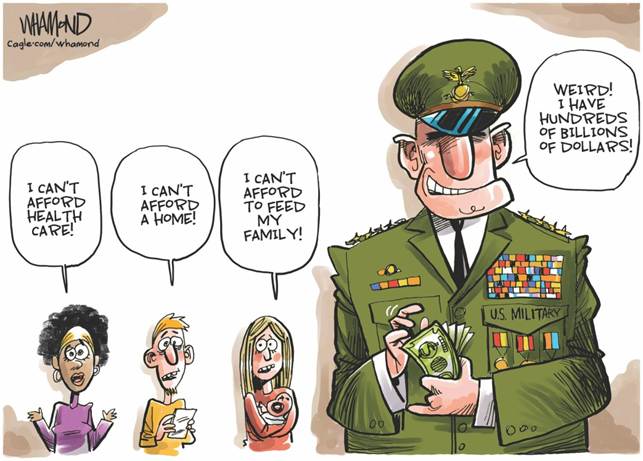
The answer to that most fundamental question is to be found in the accelerating costs of maintaining the US global empire as previously structured. It can no longer afford it, simply put.

According to its own budget data, the US now spends more than $1 trillion a year on the Pentagon alone. But that’s not all its ‘defense’ spending. At least as much ‘defense’ spending is squirreled away in other parts of the budget. When adding other defense cost like Veterans affairs, Homeland Security, nuclear weapons development, CIA and intelligence ops, foreign military aid, foreign military base expenses, rising pay for its1.4m military forces and top heavy, bloated senior officer corps, plus the defense share of interest payments on the US national debt, the total actual US defense spending in 2025 was more than $2.1 trillion! 

With US annual budget deficits of $1.5 trillion a year, a national debt of $38 trillion, and interest payments on the latter already $1.1 trillion a year and rising—the US empire can no longer continue its costs as previously structured.

So it’s consolidating—back to the western Hemisphere and the Pacific basin.

That’s the bigger picture and context for the current events in Venezuela and what’s yet to come there—and throughout the western hemisphere—as the US resorts to direct military action to re-establish direct control and unchallenged hegemony in its back yard once again.

Dr. Jack Rasmus

January 6, 2026

Listen to my last two Alternative Visions shows of December 19, 2025 (Year End Review of the US Economy 2025) and January 2, 2026 (Predictions for US Economy 2026) on the condition of the US economy during the first year of the Trump regime–and my predictions where it’s headed in 2026 and beyond.

REVIEW OF THE US ECONOMY 2025

Today’s show reviews the performance of the US economy the past year. Topics covered include actual inflation, jobs and likely GDP numbers. Special focus on Trump’s 2 main economic initiatives: the $5 trillion tax cut package and Trump tariffs offensive. What have been the actual impact of both thus far? Likely impact in 2026 and beyond? Trump monetary policy browbeating the Federal Reserve to lower interest rates. Why neither corporate cost reduction via tax cuts and interest rate cuts will have much effect on the real economy. Contradictions in 21st century US capitalism that negate stimulative effects of fiscal and monetary policies. Trump record on war spending and social program spending. US Deficits, National Debt, and interest payments 2025. State of AI investing and financial bubbles (tech stocks, gold-silver, cryptos). What’s the Trump record on the trade deficit, FDI financial flows, and US dollar.

https://alternativevisions.podbean.com/e/alternative-visions-2025-us-economy-review/

PREDICTIONS FOR THE US ECONOMY 2026

As a follow up to last show’s ‘Review of US Economy 2025’, this week the show makes predictions where it’s headed in 2026. Topics include US GDP for next year, jobs & unemployment, Inflation (CPI & PCE), Fed interest rates (short & long term), continued devaluation of the US dollar and its consequences, direction of financial asset bubbles (gold, silver, crypto, stocks), AI investment & real business spending, government spending (defense vs social programs), budget deficits and national debt, US trade deficit. Impact of global trends (BRICS, sanctions, dollar demand, demand for US Treasuries by China, BRICS, etc. also discussed).

https://alternativevisions.podbean.com/e/alternative-visions-1-2-26/

Last week’s Alternative Visions show discussed the latest change to financial asset bubbles (cryptos, gold, silver, S&P stocks and AI). Why AI isn’t making any money except for big & tech corps and won’t any time soon. Latest stats on real economy consumer spending mostly just price increases since not adjusted for inflation. Manufacturing continues to contract. New housing flat. Recent govt shutdown distorting econ stats. Show addresses latest European scheme to seize Russian assets in its banks and use to fund Ukraine war. Why Euroclear in Brussels, Belgium govt, and now European central bank all against the seizure being pushed by European Commission and German chancellor Merz. (Next week: USA’s new Strategic Direction plan document and the rearming of German War Machine article in The Atlantic Mag. What does it all mean?)

Listen to my November 21, 2025 Alternative Visions radio show for discussion of the latest swings in financial asset prices for Cryptos, Gold, Stock Markets and AI. How are they related? Will contagion spread from one to the others? What’s the contagion mechanism? Why are financial assets becoming more unstable, while the real economy continues to slow? Why the recent government shutdown means October and November US govt stats are virtually worthless (as no surveys for wages, prices, jobs, GDP took place and Govt stat departments say they’ll ‘impute’ the gap between Sept. and December–i.e. make up the numbers). Why December numbers will be biased to the upside temporarily after the shutdown. (Also my latest analyses on the prospects for war in Ukraine and Venezuela)

TO Listen: https://alternativevisions.podbean.com/e/alternate-visions-financial-bubbles-become-more-volatile-fragile-latest-on-ukraine-and-venezuela-112125/

by Jack Rasmus

This past week President Trump proposed a 28 Pt. plan to Russia and Ukraine as a basis for negotiations to end the current Ukraine-Russia war, now approaching its fourth year.

What’s behind the Trump proposal? Is it a further revelation of verbal understandings agreed to between Trump and Putin last August in Anchorage, Alaska? Or something more?

Is it a political cover for Trump to finally cut military intelligence and surveillance aid to Ukraine—while simultaneously imposing additional sanctions on Russia, and perhaps Ukraine as well, to pressure both parties to commence negotiations in earnest?

Is it a Trump maneuver to enable the US to share in the exploitation of the $260 billion Russian assets frozen in Belgium and EU banks?

Is it a Trump tactic to justify further US withdrawal from involvement in the war, once the Europeans reject it, and to let the Europeans have ‘their war’ with Russia in Ukraine?

Is it, as some have argued, a clever ‘hard cop’ (Europe) vs. ‘soft cop’ (US) maneuver to get Russia and Putin to agree to another ‘Minsk III’-like temporary truce to halt the conflict on the ground so that Europe & Ukraine can buy time to recruit, rearm, and retrain forces in order to continue the conflict?

Or is it a preliminary step toward eventual real negotiations down the road—i.e. after further military conflict exhausts both sides creating a basis for real compromises and negotiations in 2026?

Up to the release of the 28 point proposals this past week, the fundamental positions of three of the four parties involved in the conflict—Ukraine, Russia, and Europe—have not changed much, if at all. Is Trump’s plan therefore about trying to move the parties off their prior hardened positions that prevent any serious negotiations.

Prior Positions of the Parties

To date, Russia has held firm to its June 2024 positions: No NATO in Ukraine; formal recognition by Europe-US-Ukraine of Russian sovereignty over the four provinces (Lughansk, Donestsk, Zaporozhia, Kherson) and Crimea; reduction of Ukraine armed forces to less than 100,000 to ensure no future threat to Russia; and Ukraine neutrality and denazification of its government.

Ukraine’s position has been the same since the onset of the conflict in 2022: no Ukraine land concessions including Crimea; reparations for Russian damages; full retreat of all Russian military forces to Ukraine’s 1991 borders; and no negotiations to begin until a ceasefire and Russia’s full retreat.

Europe’s position is full support for Ukraine’s positions; an immediate ceasefire along the lines of combat as precondition to negotiations; use of Russia’s $260 billion frozen assets in its banks to fund Ukraine’s war effort in the interim and thereafter for Ukraine’s eventual reconstruction post-war; no changes to borders as a result of force; Europe troops to be allowed in Ukraine after the war ends; and no limits to NATO expansion determined by any state outside NATO member states.

The US position under Biden agreed with the European and Ukrainian positions above virtually completely. Biden proposed, moreover, to continue to escalate US financial, weaponry, and military assistance for as long as it takes to force Russia to end the war.

Under Trump, the US position shifted, to seek negotiations and to end the war on terms of whatever is eventually acceptable by Russia, Europe and Ukraine—as dictated by the relationship of forces at the time of final negotiations.

Trump and the US have therefore swung between a solution preferred by the political alliance of US neocons, Europe leaders, and Ukraine to a solution advocated by other political forces within the US who have begun recognizing the impossibility of ending the war on the basis of Europe-Ukraine positions to date. Trump’s dual representatives reflect the duality of the US position: General Kellogg representing the US neocon/EU positions and Trump’s personal advisor, Steve Witkoff, the emerging more realist US view of the conflict.

US Vice-President, J.D. Vance, summarized this latter, realist view when questioned by US media this past weekend after the release of Trump’s 28 Pt. Plan: the rigid Europe-Ukraine hardline view of the past three and a half years represents the view of “failed diplomats or politicians living in fantasy land” committed to the idea that somehow “more money, more weapons, or more sanctions” will result in eventual “victory”! 

The US wants to move on from Europe’s war with Russia in Ukraine. Its imperial interests now include larger strategic concerns in the middle east (Israel-GAZA-Iran war), Latin America (Venezuela regime change plans), and western Pacific (Taiwan-China). The emerging new view is that if Europe wants to continue war with Russia, they should do so on their own, paying for it and providing Ukraine’s the military support themselves.  The new view beginning to take hold among the Trump wing of the US foreign policy elite is that the USA has more important global strategic interests and concerns beyond continuing fighting and paying for Europe’s wars or protecting Europe from its imagined threat from Russia.

Mainstream Media Complicity

The US and Europe mainstream media throughout the conflict since 2022 reflected the US neocon view that Russia’s economy was about to collapse, Putin would be overthrown by Russian political opponents, and the Russian army was weak and would quickly stop fighting.  The most recent such view is that Russia has suffered 1.5 million losses since 2022—a number even larger than the current total Russian military of 1.4 million. 

Following the announcement of the 28 Pt. plan, the New York Times provided a brief, incomplete and slanted summary of its terms.  In its very first paragraph, it described the Trump plan as one in which “Ukraine would have to capitulate on most of Putin’s demands” and that “Ukraine would gain little other than a halt to the war”.  The Times’ authors added “Russia’s economy is at its weakest since February 2022” and that Russia is facing serious economic pressures due to US sanctions—all of which is a repeat of the propaganda mantra and remains contrary to the facts stated by various western market research sources.  Another Times theme is that the Trump requirement Ukraine hold elections is about “ushering out” Zelensky—i.e. a political goal attributed to Putin.

These themes were reiterated by the European media in turn and then some. The UK Guardian clarified several important elements of the plan conveniently ignored by the New York Times. For example, it questioned who originally authored the plan? It suggested the Plan was perhaps Russia’s originally, and was passed off by US Secretary State, Rubio, as Trump’s plan. The attempt here clearly was to undermine the plan and the US role, suggesting the US was just a dupe for Russia. Rubio immediately denied the suggestion, called the Times’ suggestion “blatantly wrong” and confirmed it was a US plan, not Russia’s, reached after US discussions with both Ukraine and Russia.

That did not stop US neocon Senators from repeating the Times’ theme publicly as well, implying the plan was Russia’s not Trump’s.

Key Elements of the 28 Pt. Plan

The plan is now public and readers can review it in detail for themselves. However, the key elements are the following:

  1. Ukraine must withdraw from the two provinces, Lughansk and Donetsk. It has already been driven out of Lughansk and occupies only 25% left of Donetsk. Moreover, the area from which it withdraws in those two provinces is to remain a demilitarized zone. So per the plan Ukraine is not required to actually recognized either as Russian sovereignty.
  2. Russia must withdraw all its forces from the northern provinces of Sumy and Kharkov. Its forces in Zaporozhie and Kherson are to be frozen in place, the rest of those two provinces remaining occupied by Ukraine.
  3. The plan calls for no NATO troops deployed in Ukraine and no further NATO expansion (the latter point left unclear as to where exactly no expansion was to occur). Ukraine can join the European Union.
  4. Sanctions on Russia would be removed in steps. Russia was allowed to join the G7 as its new G8 member.
  5. The size of Ukraine’s current 900,000 military forces would be capped at 600,000.
  6. $100 billion of Russia’s $260 billion frozen assets in Europe banks would be transferred to a joint US-Russia administered fund for the reconstruction of Ukraine after the war. To which Europe will add another $100 billion but not administer.
  7. Elections in Ukraine would be held within 100 days after the final agreement to end the war.
  8. There were also numerous vague terms calling for restoration of Russian speaking Ukrainians cultural and political rights prior to the new elections.

Europe leaders initially expressed extreme displeasure with not being part of the determining of the plan, cut out of negotiations with Russia, and especially with having to provide $100 billion of Russia’s frozen assets to the joint US-Russian fund and then another $100 billion further to the reconstruction of Ukraine.

Thus, the European and US have begun early in-fighting over the spoils available after the end of the war. Whose corporations will receive the lion’s share of the proceeds from reconstruction has begun emerging as a source of contention within the NATO forces, US and European.

Responses to the 28 Pt. Plan

Russia has said the 28 Pt. proposal is a basis upon which to start negotiations. Europe has initially rejected it and it hurriedly gathered its leaders in Geneva on November 23, 2025 to craft its official rejection and alternative proposal. Zelensky and Ukraine once again took cover behind the European opposition to the latest Trump initiative, declaring its opposition to the plan as well.

Europe and Ukraine have consistently insisted that negotiations should only take place when Russia agrees to an unconditional ceasefire along all lines of combat. Ceasefire first and freezing all lines of military contact is the precondition to start negotiations. That remains the fundamental Europe-Ukraine demand, which it has been since 2022. By demanding ceasefire first, then negotiations, Europe-Ukraine in effect propose a repeat of Minsk II negotiations held in 2015 to halt Russian military activity. They want a ‘Minsk III’.

As former British diplomat, Alaistair Crooke, has explained, “they (Europe) want a ceasefire, not a solution, so they can go back in, retrain, and rearm Ukraine to continue the war”. He adds: “Europe is coaching Zelensky to say No” and it wants to continue a “controlled war”.

German Chancellor, Merz, warned if Ukraine loses it will have a profound impact on Europe politics as a whole. That’s true. Europe’s current political elite have tied their futures to the war in Ukraine and cannot retreat. To do so risks the possible fracturing of NATO and even perhaps the European Union.  So why are Europe leaders like Merz, Macron in France, and Starmer in the UK so committed to continuing the war? There are several possible explanations.

First, the war is the way to keep the USA financially, and even militarily, committed to remain in NATO in Europe. The USA military umbrella since 1945 has been profitable for Europe and politically useful for Europe’s domestic politics: not having to expend huge sums on defense (US total cost in NATO is now estimated at $32B per year) has enabled Europe to provide social benefits to its populace much greater than the US has provided to its populace.

Should the USA pull out of Europe—which Trump likely wants to do eventually to cut $32B from future US defense spending—then Europe will have to cut social benefits, raise taxes further, and/or incur more sovereign debt, in order to develop its own defense/war military industrial complex. Merz has already declared Germany will spend $1 trillion over the next five years to do so. Other European countries will have to do the same. Europe’s economy cannot sustain that expenditure without massive cuts to social benefits that will certainly result in widespread political upheaval. Europe’s economy has been limping along since 2008, growing tepidly, experiencing bouts of stagnation and mild recessions for the last decade and a half, and has been declining in terms of productivity for some time. Real wages have not risen since at least 1999 when the European Union was created.  

Europe has been steadily falling behind the US and China technologically and financially. European leaders may think a surge in military spending will energize its GDP and growth but that route holds great economic and political risks. European leaders are likely aware of the consequences. But they see continuing the war as the way to keep US involved supporting the war, to keep US in NATO providing its subsidies, and the way to buy time to transition to their own military-industrial economy. The Ukraine war is key to buy time for this economic transition. Continued war in Ukraine is the only way for Europe’s elites to justify the social benefit cuts on the agenda.

As UK diplomat Alastair Crooke has correctly observed, Europe needs the war to continue. Ukraine and Zelensky will ride the European horse into the sunset as long as they can.

Failure to end the Ukraine war is not a problem of individuals—i.e. Zelensky, or Putin, or Trump or even the ultra-nationalist/neo-nazi elements in the Ukraine government. The problem is Europe—and Europe’s US neocon allies who share its pro-war objectives as well. European leadership is committed to a long war in Ukraine, so long as Ukraine has the troops to throw into the maelstrom. However, that may be coming to an end sooner than later.

The European leadership met this past Sunday, November 23, to hammer out a response to Trump’s 28 Pts. They will inject their own demands into a new document. In essence, some new formulation of ‘ceasefire first’ and other new demands.

According to the Guardian newspaper, they will propose to amend the 28 Pt plan to include a reduction in Ukraine military forces by only 100,000 to 800,000 instead of the 600,000 indicated in Trump’s plan—neither of which Russia will agree to. They will demand the Zaporozhie nuclear power plan now occupied by Russia to be returned to Ukraine. They’ll oppose immediate reductions of sanctions on Russia or permit it in the G8. They’ll especially reject the US-Russia joint administered fund to reconstruct Ukraine. They won’t agree to no NATO in Ukraine and will reiterate European forces must be allowed in Ukraine after the war. Reports are circulating they may even call for the US to commit troops to ‘supervise’ the truce on the ground after the war, i.e. to lure the US to provide cover for future European military encroachments. Their amendments will thus constitute a ‘ceasefire’ plan, albeit couched in more clever proposals. All of which Russia will reject.

Trump’s response to Europe’s counterproposals will likely include his acceptance of whatever the Europeans propose at Geneva. He’s as much as said so. The 28 Pt plan, even with the European amendments, is just an interim document and another false start event—i.e. an ‘Anchorage 2.0’—on the road to a later more serious negotiation.

When asked by the media he admitted the plan is not the ‘final agreement’. And when queried in turn what he’ll do if Zelensky rejects it, Trump replied: “he’ll have to like it, or just keep fighting, I guess.” 

Strategically the best the US and Trump can get from the Plan is to move Ukraine and Europe off their nearly four years-long hardline positions. To create some ‘hooks’ upon which to hang future negotiations.

True negotiations will not begin until Russia takes back all the four provinces it has declared as part of sovereign Russia. Serious discussions begin only when Russia takes back all of the four provinces, stands at the Dnipr river and decides whether or not to push further west into Ukraine or to take Odessa in the south.  At that point the ‘Special Military Operation’, SMO, becomes something else. Something much larger. Alternatively, realistic negotiations might begin if and when the Ukraine army begins to collapse before Russia reaches the Dnipr, which could happen within the next 90 days given the current rate of Russian advances on the ground in the east. 

The Institute for War (IFW), a western think tank clearly allied with NATO and Ukraine, has reported up to 300,000 Ukrainian troops have deserted since the war began. At least another 500,000 have been killed or permanently disabled. Per the IFW Ukraine is recruiting 17,000 troops per month but is losing 30,000.  Russian volunteers (not draftees as in Ukraine) are joining its military at the rate of roughly 30,000/ month and its losses are much less than its recruitment. The ultimate limit to war is not finding enough money to pay for it. Nor even enough weapons. It is the manpower losses.

The war in Ukraine will end when the military conflict ends. Not vice versa—i.e. not as result of a ceasefire ending the conflict before negotiating the terms of its ending.

The Trump 28 Pt. plan will not begin the process of ending the war. On the contrary, the inevitable collapse of the plan may well lead to more escalation, not less.

Jack Rasmus

November 22, 2025

https://alternativevisions.podbean.com/e/4-financial-bubbles-growing-gold-cryptos-us-stocks-ai/

Today’s Alternative Visions show addresses the four financial asset bubbles currently expanding simultaneously and what does it mean for financial instability or crashes on the horizon. The dimensions of each are described, as well as their potential interactions. The main determinants shared are US global sanctions (depressing demand for the US dollar and its depreciation already by 10% in 2025), global economy’s economic slowdown (and investors’ rush to safety in gold, cryptos, alternative currencies), and accelerated investment in tech especially AI. Delete AI investing (data centers, etc) and US real GDP in first half 2025 was only 0.1%. How AI comprises 80% of stock price appreciation in 2025. AI bubble is already 4X larger than mortgage bubble of 2003-07 and 17X dotcom bubble of 1997-2000. Some potential scenarios.

by Dr. Jack Rasmus

August 10, 2025

Putin and Trump last week agreed to meet at a location in Alaska. Indications are the meeting will occur as soon as August 15, 2025 or soon after. In other words, in just days. Or perhaps a week or so at most.

If we’re to believe the US media, the meeting is about Trump and Putin negotiating an end to the war in Ukraine. But does the meeting signify the start of serious negotiations and the beginning of the end of the war in Ukraine? Not necessarily. There are other possible interpretations for the meeting in Alaska:

A meeting with Putin may provide the cover for Trump to finally start an actual US withdrawal from the conflict. After all, during the past nine months the US has continued to send weapons, money and provide extensive military assistance to Ukraine. While calling for Ukraine and Russia to stop fighting, the US has continued to participate directly and deeply in the conflict providing general tactical planning by high level US officers, intelligence, surveillance, reconnaissance, communications, missile targeting, manning of technical equipment like Patriot systems, training, and so on. Perhaps Trump wants to withdraw from these activities. To do so he needs to show some kind of agreement with Putin as a justification.

Another interpretation is that the meeting is really about restarting discussions on future US-Russia economic relations. These began in the months before April 2025, showed some initial progress, but then were quietly suspended. Trump would no doubt like to ink some deals on Russian commodities, especially rare earths that China has recently decided not to export to the US. And perhaps deepening US-Russia economic relations sends a message to the Chinese the US is intensifying efforts to split Russia from it.

Yet another interpretation is that the purpose of the meeting is to get Putin to agree to a general ceasefire by conceding a ‘piece of the pie’, i.e. of one or two Ukraine provinces in the east where the fighting is mostly occurring. Russia has already taken all of the Lughansk province. Perhaps Trump will offer to Russia what it already has in Lughansk. More likely is the offer of the second province of Donetsk where Russia has been gaining territory daily but has only captured perhaps 60% of the total territory. By offering him the two provinces in exchange for a general ceasefire everywhere before starting negotiations on other issues, Trump is revising his original ‘Kellogg Plan’ that called for ceasefire everywhere in exchange for nothing—which Russia has consistently rejected since Trump took office.

A fourth interpretation is that the meeting is just another clever ruse by NATO and the west to lull Russia into a general ceasefire, with no intention of Ukraine actually withdrawing forces anywhere. According to this interpretation, Trump will offer a verbal or even written promise that Ukraine will then negotiate in good faith. But if this case, it is a repeat of the 2015 Minsk agreement signed by Ukraine and by Germany and France on behalf of NATO, the purpose of which was to convince Russia to halt its destruction of Ukraine’s forces at Debaltsovo that year which save the Ukraine army from defeat. The Minsk agreement of 2015 provided Ukraine and NATO with a diplomatic victory that halted Russia militarily and bought time for Ukraine to rebuild its military and defensive fortifications in the east the next six years in preparation for war.

A fifth interpretation is the most likely, however. That argues the meeting is just a last minute maneuver by Trump to stage a grand PR event, to be followed by statements of agreements in principle by US and Russia which neither side expects will take effect. Trump thereby gets a media event in which he brags he’s successfully gotten the Russians to move toward a final agreement—after he failed to do so the past six months. Trump thus declares a media ‘win’ for himself, even though nothing changes on the ground in the aftermath and the war continues. A typical Trump ‘smoke and mirrors’ event.

Putin may even agree to such an offer and let Trump have his much needed media victory. Even if it’s just a PR event enabling Trump to exaggerate, misrepresent and brag about, it still puts pressure on the Zelensky government and its European allies to respond. If Zelensky’s response is an adamant ‘no deal’—which is almost certain—then it shows Russia is willing to move off its negotiating position to get a peace deal but Ukraine (and Europe) are not. And that weakens US neocon support to continue the war in turn—undermining their current proposals so far held up in Congress to impose 500% tariffs on Russia, secondary sanctions on buyers of Russian oil, and to provide Ukraine another $55 billion from the US Treasury. If Ukraine and Europe reject outright whatever comes out of Alaska, Russia need not agree to any general ceasefire since the minimum precondition likely for such ceasefire is for Ukraine to totally withdraw its forces from Donetsk.

It is already evident Zelensky and Europe will reject anything coming out of Alaska.

Just the announcement of the possible meeting in Alaska elicited the immediate response by Zelensky and his government that they will never agree to give Russia even one province (Donetsk) in exchange for a general ceasefire. Similarly, Ukraine’s European allies also rejected the idea of any concession and within 24 hours of the Alaska announcement publicly told Zelensky he must continue the war.

US Mainstream Media Leaks

Events that got the ball rolling toward a meeting in Alaska were set in motion by Trump’s sending his second special envoy, Steve Witkoff, to Moscow last week. (Trump’s other envoy is General Kellogg who had carried the water for the US neocons’ demands for Russia to ceasefire first, then negotiate).

What provoked Trump to send Witkoff? It may have been Putin’s signal that Russia has now only two major demands: No NATO in Ukraine and Ukraine acceptance that the four provinces (+ Crimea) are now part of Russia. This appears as a concession without Russia actually making one.

Putin’s demands since June 2024, when he stated them succinctly, include both these preceding prime demands but also several more: political neutrality by Ukraine, reduction of Ukraine’s military to a force no larger than 80,000, denazification of its government, and restoration of rights for ethnic Russian Ukrainians. These latter points were not referenced by Putin who emphasized just the first two. That may have been interpreted by Witkoff, who then convinced Trump the Russians may be open to direct negotiations and a meeting. It was highly likely it was then that Trump sent Witkoff to Moscow.

That this was the likely scenario that led to the announcement of a meeting was leaked by the Wall St. Journal and Bloomberg News late last week. As the Journal suggested, Witkoff carried Trump’s proposal to Putin for Russia to agree to a general ceasefire, providing Ukraine withdraw all its forces remaining in Donetsk where fighting is the heaviest. In exchange for the withdrawal, Putin would agree to ‘freeze in place’ immediately all Russia forces elsewhere in Ukraine. The Journal and Bloomberg interpreted this to also mean Russia would in turn give up the unoccupied areas of Kherson and Zaparozhie provinces. But there’s no evidence of this and it is impossible Russia would, given that all the provinces have been formally integrated into the Russian Constitution and Putin could never agree to do so short of changing the Constitution.

Of course, Zelensky has also declared the four provinces and Crimea are part of the Ukrainian Constitution and are non-negotiable. What this means is one side or the other has to confront a Constitutional crisis in order to negotiate an end to the war. That will not happen. It is likely there can never be a compromised, negotiated settlement to the war—short of one side or the other (Ukraine or Russia) capitulating completely on the battlefield.

So why did Trump ever think he could single handedly negotiate a settlement to the war? Was he so blinded by his ego to think it was no different than negotiating some phony business deal? Was he misled by his neocon advisers the past six months not communicating the actual positions of the parties? Perhaps he wants a meeting to hear for himself? Not what his advisers tell him. Does Trump know so little about the origins and history of this conflict and their respective publics’ support? Why did Trump abandon his initial efforts to withdraw the US from the conflict and around April bend to the demands of the neocons and US Deep State and their EU allies, none of whom actually want an end to the war on any terms. Their Kellogg Plan got nowhere. Now Trump is desperate to try something else. So he grabbed at the possible shift by Putin and sent Witkoff to offer Putin something more substantial.

The Kellogg Plan is DOA, as the saying goes. So what does Trump do now? By pushing the Kellogg Plan the past six months, Trump put himself in the corner, appeared to have failed by August, thereafter threw out some threats and an ultimatum that Putin had 50 days to end the war, then cut it to 12, rattled his saber about sending US nuclear subs closer to Russia, and sent some old nuclear gravity bombs to Britain. He then flip flopped again just days before the 12 day deadline was up and sent Witkoff off to Moscow.

What’s Next Post Alaska?

It doesn’t matter what’s discussed at the Alaska meeting. Or what is or isn’t agreed to or announced afterward in the official ‘read out’ summary report of the meeting, as it’s called.

Nothing will change on the ground. The war will continue. Why?

Because Zelensky, his European backers Starmer, Merz, Macron, and their US Deep State allies (Graham, Blumenthal, CIA, State Department)—along with mainstream US corporate media outlets like NY Times, Washington Post, MSNBC et. al.—all want the war to continue.

Zelensky and the Europeans will reject whatever comes out of the Alaska meeting. Moreover, they will try to do everything they can to scuttle it before—with the cooperation and assistance of their US neocon friends. Both the Europeans and Zelensky will desperately try to get to Trump before the Alaska meeting. Both know face time is the key to turning Trump around.

It’s worked before. It was how last spring when Trump was in Rome and the Vatican they got to him personally. He flipped and assumed a neocon position and had Kellogg take the lead. Witkoff was ‘back-burnered’. Europeans have learned the formula for dealing with Trump: appeal to his ego, inveigle him with flattery, grovel if necessary. They even call him ‘daddy Trump’—as NATO’s director Rutte recently did—when they meet with him. They’ve reportedly even dangled arranging a Nobel peace prize for him.

Both Zelensky and the Europeans will try desperately to inject themselves into the Alaska meeting. They’ll work out a plan with their US neocon friends to step up the pressure on Trump at home in Congress. Their security services may even try to float a false flag threat that if Putin goes something dangerous will happen to him, hoping the Russians thereby cancel.

One should not discount any of these possible counters or that Trump may be convinced to shift gears once again. One need only remember Trump’s aborted efforts in his first term to meet with North Korea’s president Kim and with China’s Xi, both initiatives were thwarted by his neocon advisers and Deep State policy makers.

For it is increasingly clear the past half century at least that US presidents don’t determine US foreign policy or its wars. They are but one of many political ‘nodes’ in the system that do. And the neocons and Deep State—along with Israel and its deep influence over the US government—are the arbiters and deciders of US foreign policy in the 21st century.

In conclusion therefore, one should not expect much from the upcoming Alaska meeting between Trump and Putin, assuming it even comes off. Much can and will happen in the next five days. At best it will be a media and PR event by Trump. It will have little to no effect on the continuation of the war in Ukraine. And there will be no Minsk III or IV or even Istanbul 2.0. The war will be decided on the front line, as has always been the case.

The war in Ukraine will continue so long as Zelensky and his crew are in power. They will remain in power so long as the Europeans want to continue the war. European leaders want to continue in order to rescue their two decade old stagnant economy, hoping they can revive it with a $1 trillion new expenditure and weapons industry by 2030. And the US neocons who remain deeply entrenched in the US political system want it.

Their combined grand strategy is to keep Trump in check for the next three years, block and thwart his foreign policy initiatives, wait him out, replace him in 2029 with another more amenable US president again, hope that Putin disappears from the political scene by then—and then escalate the war again.

Jack Rasmus is author of the recently published book, ‘The Scourge of Neoliberalism: US Economic Policy from Reagan to Trump’, Clarity Press, 2020. He publishes at Predicting the Global Economic Crisis

This past week was punctuated by a perfect storm of negative US economic reports and events. Together they mean the door to recession in the US has now opened—quite contrary to all of Trump’s hype that the US economy is doing great.

The reports in question are the July jobs report lasts Friday and the advanced (preliminary) US GDP report for the 2nd quarter (April-June) released a few days before. The events associated with these reports were (1)Trump’s announcement imposing widespread tariff hikes ranging from 15% to 41% on more than 40 countries, with even higher tariffs previously announced on China, Russia, Mexico, Canada as well as ‘across the board’ global tariffs steel, aluminum, copper and other commodities; (2) and The Federal Reserve bank’s decision to keep US interest rates at current levels for at least another six weeks.

If last week’s 2nd quarter GDP data unlocked the door to recession, then last Friday’s Jobs data kicked it wide open. And Trump’s tariffs coming behind threaten to blow it off its hinges.

The Jobs Data Tsunami

It’s generally acknowledged that jobs are a lagging indicator of the condition of the US economy. If so, the July Jobs report shows that there’s no more lag. Jobs have caught up and Friday’s August 1, 2025 report shows Labor Market conditions in the US economy are now flashing red.

According to the US Labor Department’s Establishment Survey (CES) only 73,000 net new jobs were created in July. Moreover, this number is likely to be downward revised, since the July jobs report also revised its previous May and June reports downward big time: for May, the jobs created were reduced from an initially reported 144,000 jobs created that month to only 19,000 in fact: for June, the revision was from 147,000 to 14,000. So when July is similarly revised, it’s highly likely the 73,000 will be reduced dramatically as well. This will mean the total jobs created over the past three months will be barely 50,000!

It’s generally acknowledged the economy has 125,000 new workers entering the labor force and economy every month. The economy must therefore create that many jobs every month just to absorb new entrants, mostly youths seeking jobs for the first time. Only 50,000 created means more than 300,000 are entering the ranks of the unemployed not gainful employment.

The US Labor Department has a second jobs survey to the CES, which covers mostly large companies. The second survey is called the Current Population Survey or CPS. It covers more small and medium sized businesses as well as unemployment levels the CES does not report. The CPS report on Friday showed that new entrants’ unemployment rise by 275,000 in July.

The plight of new workers seeking employment is not the only negative indicator of a rapidly deteriorating US labor market this summer. Here’s some other telling job indicators:

  • The general level of employment in July fell by -260,000. It would have been an even greater decline had the level of part time employment not also risen by 433,000 as well. No doubt many companies converted their full time employed workers to part time in lieu of laying them off. Conversion of full time to part time typically occurs with the onset of early stages of recession.
  • Beyond just July, the CPS revealed that since May 1 the Employment level for the US economy in general declined by -863,000.
  • The unemployment rate, also indicated by the CPS only, remains at approximately 8% for the entire US labor force of 170 million—not the ‘official unemployment rate of 4.2% one consistently reported by the mainstream media and hyped by politicians. The 8% includes the 50 million plus part time, temp, discouraged, independent contractor, gig and similar job categories that the ‘official’ 4.2% excludes.
  • The 8% means there’s roughly 14 million US workers unemployed or underemployed. Of that 14 million, those unemployed long term (more than 27 weeks) has risen sharply as well over the summer. In July alone their numbers rose by 179,000.

Multiple statistics show the band-aid has been ripped off the obfuscation of the real condition of the labor market that has prevailed for at least this past year, exposing the long festering wound beneath.

The labor market has been weak for some time, as this writer has been reporting repeatedly over the past year. One needed only to look behind the mainstream media’s cherry picked reporting of the most favorable numbers in the two jobs reports, ignoring other data in the same reports that were growing consistently weaker.

What’s different the past three months, and in the July report in particular, is that the real rot in the jobs market could no longer be covered up by selective media reporting or by politicians’ hype.

Trump’s response to the recent jobs data has been to shoot the messenger, as he quickly announced his firing of the Labor Department’s statistics chief. But there’s no politically ‘cooked numbers’ to make him look bad here, as Trump claims. It’s just that the facts have now deteriorated to such an extent that even efforts to pave over the pot holes with marginal under-reporting and selective media reporting can no longer cover up the true condition of the deteriorating jobs ‘road-bed’.

The US GDP April-June Report

The second report indicating the US economy now balances on the precipice of recession is the advance (preliminary) US GDP report for the 2nd Quarter 2025. Here’s just three reasons why the announced 3% growth rate is not actually 3%.

First, readers should understand the US, virtually alone among advanced economies, puffs up its quarterly GDP numbers by multiplying the quarter change from the previous quarter by annualizing it. That is, 3% for the 2nd quarter is actually 4 times roughly what the economy actually grew from the previous 1st quarter.  3% sounds a lot better than 0.75% if one is publicly hyping the growth rate in the media.

However, even the 3%(0.75%) is grossly over-estimated for several reasons. Here’s just two of many: First, real GDP is artificially boosted by under-estimating the real rate of inflation. This occurs every report. Second, in the case of the 2nd quarter GDP report, the 3% is grossly over-estimated by temporary effects due to Trump’s current tariffs policies now rolling out which has dramatically distorted the contribution to GDP from what is called ‘net exports’—i.e. the difference and gap between imports into the US and US exports to the rest of the world.  For decades, imports have significantly exceeded exports. The result is that ‘net exports’, as the gap is called, has been a consistent subtraction from GDP from other categories like consumer spending, business investment, and government spending.

Let’s look at the under-reporting of real GDP due to low-balling inflation, and then the volatile impact of Trump’s tariffs on GDP for the entire first half of 2025.

(How Under-Estimating Inflation Over-Estimates GDP)

When the government reports GDP it’s for what’s called ‘real’ GDP. Real means adjusted for inflation (unadjusted is called ‘nominal’ GDP). The media reports the ‘real’. For the 2nd quarter that was the 3%. The problem is the inflation adjustment used greatly understates actual inflation. And the more it underestimates actual inflation, the more in turn real GDP is over-estimated.

The price index used to estimate real GDP is called the PCE. For the 2nd quarter the PCE was 2.1%. In the first quarter it was higher, at 3.7%. So simply by reducing PCE from 3.7% to 2.1%, all things equal the real GDP of 3% was boosted by a 1.6% lower PCE in the 2nd quarter.  If PCE in the 2nd quarter was 3.7% as in the 1st quarter, then 2nd quarter real GDP would be 1.4% instead of the reported 3%.

Ok. Some will argue perhaps inflation did abate significantly in the 2nd quarter compared to the first. Perhaps inflation was indeed 40%+ less in the 2nd compared to the 1st. But whichever the quarter PCE grossly underestimates actual inflation for dozens of reasons due to faulty assumptions and questionable methodologies used by the government to get PCE. Don’t think the government actually goes out and surveys price changes by businesses to get the PCE, like it does the other price index called the Consumer Price Index. It doesn’t. PCE is determined totally by estimating prices from other sources than the actual prices charged by businesses.

For example, let’s take insurance costs for home, auto, etc. which have been surging the past year. Insurance prices aren’t surveyed. They are extrapolated from insurance company profits. If the big insurance companies hide their profits in order to pay less taxes—which they do—then insurance inflation is grossly underestimated. But that’s what happens with PCE. How about rent inflation. Rents in the PCE index are calculated from reported new rental contracts from a subset of big apartment owners. Landlord price hikes for renters with existing contracts do not report price hikes within the term of the rental contract. There are dozens such examples that result in PCE underestimating actual inflation. Nonethless, PCE is used to low ball actual inflation in order in turn to over-estimate reported ‘real’ GDP. In short, 3% GDP in 2nd quarter is not actual GDP because PCE inflation is not actual inflation.

There are many other ways GDP in general is always over-estimated, apart from the faulty inflation adjustment. There are issues with seasonality adjustment methodologies. There are issues with how GDP is periodically re-defined in order to make it look larger. The latest such example was in 2013 when the government included as business investment items like business logos, trademarks, R&D expenses, IP and other similarly un-estimable values. The government simply accepts whatever businesses tell it are the increase in value (and thus price) of these ephemeral items, and then adds them to GDP.  When first introduced more than a decade ago, this boosted real GDP from business investment by more than $500 billion a year. Thus real business investment and its contribution to GDP is, and has been, less than reported every year.

Trump Tariffs & Volatile Net Exports

The even bigger reason why the 2nd quarter GDP growth of 3% is misrepresented has to do with Trump’s recent tariffs and trade policies. Briefly stated: nearly all of the 2nd quarter 3% GDP growth was due to the collapse of imports to the US economy in the quarter in response to Trump’s tariffs.

In the 1st quarter 2025, companies increased their imports excessively in anticipation of Trump’s coming tariffs. That artificially exacerbated the gap between exports from the US and imports to the US. A big negative number resulted, as imports exceeded exports by a wide margin. Imports thus subtracted from overall GDP calculation in the 1st quarter, overwhelming the effect on GDP from government spending, consumption, and business investment. GDP thus contracted by -0.5% in the first quarter. Virtually all due to the effect of import surge.

This flipped in the 2nd quarter. Imports that formerly surged in the 1st quarter collapsed in the 2nd. The difference between imports and exports now added to GDP. How much? Around 5% or 2% more than the actual 3% GDP. So what subtracted from the 5% to get the 3%? Business investment contracted, government spending flattened to virtually zero and consumption slowed. That knocked 2% off the 5% from imports-exports to get to the 3%.

Considering both quarters, it’s clear tariff policy and its impact on exports and imports, especially the latter, is distorting the numbers for GDP in the first half of the year 2025.

But beneath this what’s happening is business investment, a more permanent and less volatile factor in GDP determination, is steadily falling. In part due to tariff and trade volatility but also due to more fundamental forces and developments within the US economy. The same can be said for consumer spending, now steadily slowing even if still growing. In addition, Trump fiscal policies—spending cuts for social programs, government employment, and department dismantling are also building pressure toward less government GDP contribution.

US Economy Next 6-12 Months

The US economy is now at the precipice of recession and will likely deteriorate further over the next 6 to 12 months, and especially so in 2026. Here’s why:

Trump’s ‘big beautiful bill’ Act just passed by the Congress will have a net negative impact on GDP, and will not boost US economic growth as Trump claims.

Most of the at least $3 trillion in corporate and individual (and estate) tax cuts are just a continuation of previous 2018 cuts. The effect of the 2025 bill is just to make them permanent. That’s not net new fiscal stimulus from tax cutting. Meanwhile, the so-called working class $500 billion tax cuts in the bill—for tips, overtime pay, social security, interest on new cars, etc.—have been dramatically reduced and made temporary.

In contrast, the program and employment spending cuts in the bill—for Medicaid, ACA subsidies, education, layoffs of federal workers, and so on—amount to at least $1.5 trillion and take effect immediately. They will significantly reduce current consumer spending this year and next. Furthermore, Trump’s cuts in spending and layoffs will soon begin to spill over to state and local government spending cuts and layoffs, as the states will have to make up for reduced Federal government support and find ways to continue education, health and other spending from their own budgets. They too will have to begin layoffs and cuts to programs, both of which will exacerbate consumer spending in their states.

Add to all this what economists call the ‘multiplier effects’. Tax cut multiplier effects are less than spending cuts multiplier effects. Tax cuts don’t immediately result in more investment by businesses or wealthy investors. They lag. Moreover, the more the cuts accrue to the more wealthy and corporations, the less is actually spent of the total cuts. Some of the cuts are just hoarded. Some are distributed to shareholders as stock buybacks and dividend payouts. Some are invested in financial asset markets, none of which add to GDP. And some are redirected to offshore investment which also contributes nothing to US GDP. So tax multiplier positive effects are relatively low, and increasingly so in the 21st century as the US economy has globalized and financialized.

In contrast, the multiplier negative effects from spending on programs and jobs are immediate and much higher. This is especially more so, to the extent the spending cuts negatively impact incomes of middle to low income levels, which the Trump spending cuts clearly target. In other words, the composition of the Trump tax and spending cuts are net negative and exacerbate the negative multiplier effects of the combined tax and spending cuts as well.

In summary, over the next year US GDP is likely to weaken due to less consumer spending—as state and local government layoffs rise and Trump spending cuts take effect as well as due to less immediate and historically low impacts of tax cuts on the real economy—while the short term positive effect on Imports-Exports on 2nd quarter GDP dissipates.

The recent Jobs and GDP reports reveal the door to near term recession has opened. Trump tariff, tax and spending policies will likely kick it wide open as they take effect.

Jack Rasmus

by Jack Rasmus

Last week the US Congress passed the Trump Tax Cuts. The mainstream media and economists have been mostly reporting the details of the cuts — i.e. which taxes got cut in the 2025 Act, how much accrued to businesses and wealthy as opposed to the rest of us, what’s the impact on GDP and maybe even government deficits and debt. 

All interesting facts. But not the most important. They purposely ignore the cuts in historical perspective and the bigger picture they represent.

That bigger picture is the looming fiscal crisis driven by the growing convergence of runaway tax cutting since 2001, chronic escalating defense and war spending, more frequent deeper crashes of the economy with slower economic growth between, and now since 2022 accelerating trillion dollar annual interest costs on the US national debt.

The US national debt is on track to reach $38 trillion by year end 2025. Interest payments to bondholders are already exceeding $1 trillion a year. The Congressional Budget Office, research arm of the US Congress, estimates the national debt will reach $56 trillion by 2034 with interest payments of $1.7 trillion — and all that before Trump just passed $5 trillion tax cuts.

Moreover, the US elite today show no sign of addressing the coming fiscal crash. It continues to:

  • cut taxes by trillions on corporations, investors and wealthiest 1% households
  • raise spending on the Pentagon, wars and other ‘defense’
  • allow health insurance and big Pharma to gouge the US Treasury
  • pay holders of US securities—foreign and US—trillions of dollars more every year

Multiple studies show that historically 60% of the US budget deficits and thus national debt are due to insufficient tax revenues — from chronic tax cutting, slow economic growth, legal avoidance and fraud. Here’s some interesting facts about cumulative tax cuts by both political parties together since 2001.

Cumulative Tax Cutting 2001-2025

George W. Bush’s tax cuts in 2001-03 amounted to $3.8 trillion over the decade 2001-10. Estimates are roughly 80% accrued to corporations, businesses, and wealthy individuals by focusing overwhelmingly on individual income tax rates, corporate capital gains and dividends, and the estate tax affecting the wealthiest 1% or less households. Bush then cut taxes in the spring of 2008 by another $180 billion as the economy began to slide into recession and the great crash of 2008-09.

When Obama took over in 2009 his American Rescue Plan stimulus for the economy passed that March provided for another $325 billion in tax cuts. His entire stimulus plan was $787 billion, another $280 billion of the remaining $487 billion went to the states which then hoarded most of it. 

So less than $200 billion went to stimulate consumption which immediately proved too little to reboot the US economy. He had to add another $25 billion for ‘cash for auto clunkers’ and another $25B for ‘first time home buyers’ later that year. Most of the latter, moreover, didn’t go to home buyers but to mortgage lenders as incentive to approve more mortgages.

When Bush’s tax cuts came up for renewal in 2010, Obama extended them for another two years through 2012. That amounted to another $803 billion in tax cuts, again mostly to wealthy and corporations.

In August 2011, in an agreement with the Republican Congress, Obama cut social program spending by $1.5 trillion in a new ‘austerity’ plan. $1 trillion was cut in just education and other social programs; $.5 trillion was supposed to be cut for defense spending but was kicked down the road and never applied. 

Austerity social program cuts always follow crisis bailouts. They did in 2011 after the 2009-10 bailouts. They’re occurring again today in 2025 after the 2020-21 Covid bailouts — more on which shortly.

The 2012 Obama tax cuts made the Bush tax cuts permanent. They cost another $5 trillion. They were supposed to avoid what the media, lobbyists, and propagandists called the pending ‘fiscal cliff’. They were supposed to boost the economy. 

They didn’t. US economic growth in GDP terms for the rest of the Obama term averaged only 60% of what was historically average during recovery periods from the earlier 10 US recessions since 1948.

Obama thus cut taxes on wealthy and corporations more than Bush did. To restate: Bush cut by $4 trillion ($3.8 trillion + $180 billion). Obama cut by $325 billion (’09) + $803 billion (’10-11) then by $5 trillion (2012). That’s $4 trillion (Bush) and $6.1 trillion (Obama). Then came Trump’s $4.5 trillion in 2018.

Trump promised during the 2016 election to cut taxes by $5 trillion. And he roughly did. The 2018 tax cut over the next decade cost $4.5 trillion.

His administration, with the media and professional economist class in tow, estimated the $4.5 trillion at only $1.9 trillion. Trump’s Treasury Secretary at the time, Steve Mnuchin, even publicly declared the Trump tax cuts would ‘pay for themselves’. 

By that he meant the tax cuts would boost US GDP and the economy so much that economic growth would result in a rise in so much more tax revenues over the decade that would offset the $1.9T. To quote Mnuchin at the time: “we believe the tax cuts will pay for themselves over a 10 year period of time.”

Proof that the Trump 2018 tax cuts were $4.5T — not $1.9T — was reflected in the Trump administration’s budget forecast and a US federal deficit reduction of $4.6 trillion over the decade 2018-28. An even more convincing later piece of evidence was the US Congressional Budget Office, the research arm of Congress, that estimated in 2025 that the cost of the 2018 tax cuts were at least $4 trillion total!

For several years in debates with professional mainstream economists like Robert Reich and Paul Krugman this writer kept showing the Trump tax cuts weren’t $1.9 trillion but actually $4.5 trillion. Here’s how.

First, the $1.9 trillion official estimate was based on the assumption that the US economy would grow over the next ten years, 2018-28, by 3%-3.5% annually. A forecast that proved grossly inaccurate in fact.

After a modest growth in 2018-19, the US economy crashed in 2020 as the government ordered a partial economic shutdown in response to Covid. The economy haltingly reopened and recovered in stages in 2021. Thereafter it grew only moderately from 2022-24.

That modest three year GDP recovery followed the massive $10.7 trillion fiscal and monetary stimulus by Congress and the Federal Reserve during the years 2020-22: $6.7 trillion in fiscal stimulus and another $4 trillion in monetary stimulus by the Federal Reserve Bank. In other words, a mountain of stimulus brought forth a molehill of GDP.

Second, the 2018 tax cut estimate grossly under-estimated and failed to account for the magnitude of tax cuts that accrued to US multinational corporations offshore.

The largest 108 US Fortune 500 corporations with offshore subsidiaries had accumulated $2.7 trillion in their corporate offshore accounts they weren’t returning to the US in order to avoid paying the then 35% corporate tax rate. Estimates of un-repatriated hoarded profits from the offshore operations of US multinationals were as high as $4 to $5 trillion. 

Trump’s 2018 tax cuts allowed them to bring back those profits and pay only 10%. That’s a 25% tax saving on at least $4 trillion. 

The US Commerce Dept. estimated in 2020 US multinationals brought back only $750 billion in 2018 and another $250 billion in 2019. They thus paid 10% or $100 billion instead of 35% or $350 billion. They pocketed the other $900 billion of the $1 trillion repatriated. No government records were kept after 2019 unfortunately.

What did they do with the $900 billion they did repatriate? As the Wall St. Journal reported on January 28, 2020: “Much of what firms retrieved went to buybacks”. After averaging about $125 billion per quarter in 2017, S&P 500 stock buybacks surged to $200 billion per quarter in 2018 and 2019.

And what happened to the other roughly $3-$4 trillion plus US corporations never repatriated? They hoarded the remaining $3 to $4 trillion profits in their offshore subsidiaries to avoid taxes. Another loophole allowed them to convert their cash profits from overseas operations into short term financial securities held offshore, on which they didn’t have to pay any profits.

And there was another way they avoided taxes: they manipulated their internal pricing — i.e. what US located operations charged or paid their foreign subsidiaries. They paid their foreign subsidiaries higher prices for components or final products, thereby shifting profits offshore where they were booked at lower tax rates, which also raised costs in the US and thus lower profits taxed at the higher rate.

The 2018 Trump tax act also raised the amount US multinational corps paid to foreign countries that they could then deduct from their US taxes owed.

The point is these offshore rules and loopholes that grossly reduced the total tax cuts by at least $2 trillion over ten years, 2018-28, that were grossly under-estimated or were not accounted for in the 2018 Trump official $1.9 trillion tax cut cost estimates.

In summary, phony assumptions about a decade of future GDP growth, reduced taxation on repatriated profits, and loopholes reducing taxes due on their offshore subsidiary operations all meant US multinational corporations’ tax cuts were far greater than reported. These assumptions and loopholes meant the 2018 cuts were $4.5 trillion not the ‘official’ $1.9 trillion.

Thus total tax cuts for 2001-19 were $14.6 trillion.

Thereafter followed the 2020 Covid fiscal stimulus package during Trump’s last year in office, 2020. Taxes were cut another $950 billion as part of the ‘CARES Act’ fiscal stimulus passed by Congress March 2020 and another $260 billion in tax cutting in the emergency ‘Consolidated Appropriations Act’ passed that December as the US economy faltered again.

That $1.2 trillion in 2020 tax cuts was followed in 2021 by Biden’s subsequent ‘AMERICAN RELIEF PLAN’ fiscal stimulus which cut taxes by a further $640 billion.

In 2022 Biden thereafter shifted some of the unspent relief for social programs in his American Relief Plan and redirected the funds to a new round of three business investment stimulus programs costing $1.7 trillion: 

  1. the Infrastructure Act
  2. the Chips & Modernization Act
  3. the misnamed Inflation Reduction Act which was mostly tax cuts and subsidies to energy companies, alternative and fossil fuel

Those three 2022 business investment Acts together cut taxes by another roughly $500 billion.

Adding all the tax cuts from 2001 thru 2024, both parties — two Republican and two Democrat administrations — together cut taxes by almost $17 trillion!

No one should therefore be surprised that Trump 2025 is cutting taxes again by another $5 trillion — and once more mostly for business, investors and wealthiest households. A massive tax cutting has been going on for a quarter century since 2001. (One can argue the trend extends even further back, to Reagan’s 1981 and 1986 tax cuts and Clinton’s 1997-98 cuts).

It’s all part of the long term Neoliberal era (1979-present) fiscal policy: 

  • cut taxes on the rich and their corporations
  • offset the cost of the tax cuts in part with social spending program cuts
  • increase spending on defense and wars
  • ignore the effects of all that on budget deficits and national debt that result in rising interest payments to US bondholders to $1 trillion dollars per year

Long term historical studies show conclusively that tax cuts, and reduced tax revenues from slow economic growth, fraud, legal avoidance, are responsible for 60% of budget deficits.

The other major forces driving US budget deficits and national debt since 2001 are: 

  • the $9 trillion spent on foreign wars in the first quarter of the 21stcentury
  • the two big bailouts of 2008-09 ($787 billion +), 2020 ($3.1 billion) and 2021 ($1.9 billion);
  • the chronic price gouging by health and insurance corporations escalating the costs of government health support programs (Medicare, Medicaid, Schip, ACA)
  • rising interest payments on the national debt to investors (US and foreign) purchasing US Treasury securities

So loss of tax revenue from 25 years of tax cuts and slower long term economic growth ($17 trillion), the $9 trillion thrown away in forever wars since 2001, the bailout costs ($5.8 trillion), and healthcare price gouging ($0.5 trillion?) together explain most of the current $36.2 trillion US national debt.

In short, a fiscal train wreck has been running down the tracks for at least the past 25 years and Trump’s $5 trillion ‘Big Beautiful Bill’ (BBB) — along with trillions more for defense and wars — are shifting that train into another higher gear.

Trump, Budget Deficits and National Debt

US budget deficits have been averaging $2 trillion annually and rising since 2016. They are projected to rise another $2 trillion in 2025 even before Trump’s tax cuts take effect this year.

The national debt is just the accumulation of annual budget deficits. In 2000 the US national debt was $5.6 trillion. After eight more years it nearly doubled to $10.7 trillion. It then did double under Obama to $20 trillion by end of 2016. Trump added $7.8 trillion in the four years of his first term and Biden added another $8.5 trillion in just four years more. By the end of his Biden’s term in December 2024 the national debt had risen to $36.2 trillion.

By the way, as that rises to $38 trillion by year end 2025 and $56 trillion by 2034, it does not include the Federal Reserve Bank’s balance sheet debt (now $8 trillion) or state and local governments’ debt load of several trillions$ more.

Future Consequences

It’s ironic Trump has chosen to call his tax cuts and defense spending hikes proposal the Big Beautiful Bill — or BBB as Congress refers to it. For in the world of business finance, BBB refers to the worst run corporations that are overloaded with high risk debt (triple B grade). Triple B rating makes them the most financially fragile and at greatest risk of default and bankruptcy.

While it’s not likely the USA federal government can ever go bankrupt or even default on its annual payments of $1 to $1.7 trillion to bondholders of the national debt. All it needs do is ‘print’ more money, either by adding accounts to the Federal Reserve electronically — or perhaps in the near future by creating digital currency. 

But while that may not mean bankruptcy, it could very well mean a collapse of the value of the US dollar globally. That in turn could result in the abandonment of the dollar as the global reserve and trading currency. And that in a collapse of the recycling of US dollars back to the USA by foreign holders of excess dollars. In such case, the US annual budget can’t be financed, requiring then massive spending cuts and tax hikes. In other words, the end of the US global empire.

Trump’s tax cuts and spending bill is just another iteration of Neoliberal fiscal policy, this time on steroids. But Neoliberal fiscal policy is broken. That is, it does not produce the same stimulus to the real economy, real investment, and GDP growth that it had in decades past. Increasing magnitudes of fiscal stimulus is required in order to generate the same, or even smaller, real GDP growth.

What fiscal policy does result in increasingly is a stimulus to financial asset markets, in US and globally, and thus a continued rise in stocks, bonds, forex, derivatives and other financial instruments’ price. Or the tax cuts are redirected by multinational corporations that receive them to offshore investment and operations. 

In other words, to subsidize the expansion of US capital expansion offshore. Both the financialization and globalization of investment are characteristic of trends in the 21st century capitalist economy. A similar effect applies to US monetary policy: more and more of the Federal Reserve’s injection of money into the economy gets diverted to financial markets and to offshore.

Perhaps the best evidence of this is the $10.7 trillion in fiscal and monetary stimulus by Congress and the Federal Reserve injected in 2020-22. It should have produced a massive GDP growth expansion in 2022-24. It produced a mere historical average of barely 2%.

All of the media, economists, and government officials’ about the Trump tax cuts and BBB Act stimulating the real economy — i.e. wages, jobs, investment, etc. — is just economic hype. The 2018 tax cuts didn’t. Nor did Obama’s and Bush’s before that. Trump’s current BBB Act won’t do any different.

Fiscal and monetary policy in the late Neoliberal era — in the 21st century American capitalism and global economic empire — are failing. Nevertheless, America’s elite are doubling down on their tax cutting for the rich and their wars of defense of Empire.Jack Rasmus is author of the recently published book, ‘The Scourge of Neoliberalism: US Economic Policy from Reagan to Trump’, Clarity Press, 2020. He publishes at Predicting the Global Economic Crisis

Dr. Jack Rasmus

Copyright 2025

After promising during his 2024 election campaign to end the country’s quarter century of ‘forever wars’—on June 21, 2025 Trump started yet another ‘forever war’ by bombing Iran at multiple locations. He thus declared war today on Iran without a formal declaration, much like Japan did with the USA on December 7, 1941.

Also like Japan in 1941, Trump conducted fake negotiations over the past two weeks with Iran as a deception, to make Iran think a deal was possible when in fact he never intended a deal. The attack was inevitable days ago, once the US started moving two more US carrier task forces to the region, removing its naval assets out of its Bahrain and Qatar bases in the Persian Gulf, and calling on Americans in the region to leave. All indicators Trump made his decision to bomb likely a week ago.

The deception of fake negotiations this past week continued up to the very last minute. Two days ago Trump announced he was giving Iran two weeks more to consider his demands. As he said that, US air force B-2 bombers were being fueled, armed and readied for takeoff. Just another deception.

Trump’s forever war on Iran is like none of the US Empire’s previous neocon wars of the 21st century.

This time there was no attempt to provide political or moral cover by going to the United Nations, as US presidents did in previous wars in Iraq in 1991 and 2003. Nor did Trump make the slightest effort to bring US allies on board to support or participate in the attack. Nor was there any pretense of invoking the War Powers Act, that imperial fig leaf that has served as cover for Presidents violating the US Constitution. All that was bypassed or ignored this time, in Trump’s ‘forever war’.

Trump’s decision to go to war was strictly personal. It was his alone—with US neocons whispering in his one ear and Netanyahu the other. That makes Trump’s war a personal act of Tyranny per the basic meaning of that term—an act in foreign policy not unlike some of his recent decisions in US domestic affairs.

Trump’s decision to bomb Iran has all the earmarks of the continuation of the US neocon global strategy in the 21st century. By bombing, Trump reveals he is now solidly in the neocon camp—if he ever left it. Trump is now America’s No. #1 neocon. 

No country will ever believe he, or the USA, ever wants to negotiate a peaceful settlement to any dispute. That applies especially to countries like China and Russia. Why negotiate with the USA? Negotiations are only a ruse. Russia found that out in Ukraine. China will no doubt take note in any future discussions about Taiwan or South China Sea islands.  

The empire sees negotiations as a tactic. Treaties are only temporary agreements until the US believes the relationship of forces are again in its favor, at which point it conveniently breaks treaties.

‘Trump’s Iran War’ is a first in the history of 21st century US neocon military adventures.  It is a first in that it is totally on behalf of a foreign country, Israel, against a country, Iran, that has not indicated any threat to America nor has the capability even if it did. Trump has gone to war with Iran not because it is in America’s interest to do so, but because Netanyahu and his Zionists have asked him to do so.

There is another ‘first’ in Trump’s neocon forever war on Iran: Trump started the war in direct contradiction to US intelligence agencies’ determination that Iran did not have a nuclear weapon and it would take it three years to develop one. That was the public statement of the Trump administration’s own Director of National Intelligence (DNI), Tulsi Gabbard, to Congress this past March. The DNI gathers and summarizes the intelligence findings of the USA’s 17 intelligence agencies, including the CIA. 

Trump publicly rejected Gabbard’s conclusions in a media interview just days ago, saying ‘she was wrong’. I (Trump) know Iran has a weapon’.  So how did Trump know? If his own intelligence apparatus said no, why did he say yes? From what source did Trump get his evidence if not from the US intelligence apparatus?  It can only be from Israel and its intelligence agency, the Mossad. So we have the ‘first’ of a US president believing a foreign intelligence source (with a vested interest) against the determination of the USA’s own intelligence.  

The bombing of Iran is clearly the outcome of the two forces on the planet that for decades have been pushing for perpetual war—US neocons and Israel Zionists. They are now obviously two sides of the same coin.  And together the two are obviously driving US foreign policy and wars.

President Biden may not have had all his mental faculties that enabled the Neocon-Zionist cabal to push him to war. What’s Trump’s excuse?

With the assistance of the US neocon cabal, Israel has become the dog wagging its American tail.

To sum up the unique character of this latest of US neocon 21st century wars of empire:

Trump’s Iran war is a first in the history of US neocon military adventures as it is a war on behalf of another country (Israel) against their adversary (Iran) not against any country threatening America; it is a first because Trump has bypassed all government processes in his march to war; it is a first because Trump has decided to go to war ignoring his own US intelligence agencies and instead basing his decision on a foreign intelligence agency (Mossad).

Some Consequences

Trump may believe now that he has bombed Iran that it will come to the negotiating table. As he said after the event: ‘It’s time for a peace agreement’.  That statement makes him either incredibly naïve and stupid, or it’s just another negotiating subterfuge.

Why would Iran now agree to negotiate a peace deal with him?  Can Iran trust him that a deal is possible again, when negotiations were just a deception before?

Trump may think this bombing ends the war. But it may only have started it.

If Iran fought against Iraq in the 1980s and lost 1 million men, why would it now capitulate and not continue fighting?  Would the USA have done so after being bombed? Did it after Pearl Harbor, Manila in the Philippines, Wake and Guam islands that were all bombed by Japan on December 7, 1941?  Does Trump and US neocons think that is the likely outcome now? It’s possible they are that stupid. They’ve shown evidence before of being afflicted with a severe case of geopolitical myopia.

It’s extremely unlikely Iran will negotiate again.  Its leadership must be aware the more fundamental objective of Trump and the US—and especially Israel—is regime change in Iran. Not just the bombing of Iran’s nuclear sites. Certainly US neocons and Israel know this is the real objective, even if Trump naively now believes he can now force Iran to negotiate a deal.

It is unclear at this point, moreover, whether Iran’s nuclear sites are actually destroyed. Time will tell.  But if so, what’s to stop Iran now from accelerating its nuclear program at other sites? The bombing may actually force Iran to now build a bomb as fast as it can. Only the total military occupation of the country by Israel and/or the USA can prevent that. And neither Israel or the USA has a military force remotely capable of doing so, let alone of even invading Iran.

If the Iranians believe the Trump-Israel objective is regime change, why won’t they continue fighting?  After all, Trump has demanded their ‘unconditional surrender’. Historically that means military occupation, new government, prosecution for alleged war crimes, and execution of former military leaders. To continue fighting is obviously a preferable alternative to ‘unconditional surrender’, capitulation and war crime tribunals.

Trump may have just ‘lit the fuse’ on the US empire’s declaration of war on the entire global south.  The bombing is a stark warning to all, and especially China, that the US is willing to escalate the use of force without limit (including nuclear) in order to preserve its global empire now being increasingly challenged by the nations of the global south.

With Trump’s war on Iran, the ‘forever wars’ not only continue now; they are likely to spread and become even more deadly.

Trump’s bombing of Iran represents a kind of ‘geopolitical Rubicon’ from which there’s now no going back.

By Jack Rasmus

June 21, 2025